
I warn that this post is boring and whiny. I promise to do better next time. I wrote it after an 8 hour overnight bus trip in which we were told at 4:30 AM that we were going to take a 40 minute break at a rest stop and everyone had to get off. Basque Country will come soon...all in good time.
As my time in Madrid is beginning to rap up (two weeks for me), my program-mates and I have begun to get a little sentimental and do the whole meta-trip conversation thing when we occasionally run into one another while trying to use our printer in the office, since otherwise we're off on our own thing. Some people definitely talk about being in love with Madrid and being not able to imagine leaving. I think by and large these were the people who actually fell in love in Madrid, and the "with" part was the side effect, but maybe I'm just cynical. For me, I would say my feelings are best described by saying Madrid is just a good friend (metaphor stolen). Our relationship is pretty mundane, and while we enjoy spending time together, I won't be totally heartbroken leaving. In many ways, my departure seems more like a high school graduation than a breakup - we're both going our own ways, but we'll probably see one another again sometime.
If Madrid is my good friend, my trip this weekend to Barcelona revealed it to be a very attractive, if often annoying acquaintance. Sometimes I would convince myself into believing I really liked the character of the city, only to realize again that I was just taken with the old neighborhoods, nice beaches, and pretty modernist architecture. Don't get me wrong - I really liked Barcelona for these features, it's just not a very interesting thing to write about. The old neighborhoods are really well preserved and very pretty (not to mention the unbelievable Roman remains under the city), the beach was a nice place to spend the evening, and some of the areas (e.g. L'Eixample and Parc Güell) seemed like Gaudi-based fantasy lands. Also, Plaça d'Espanya is incredible at night. I wouldn't want to give the impression that I had a bad time; I just have zero desire to describe individual sites, so my overal positive feelings about the trip will just have to be taken at my word.
Perhaps the single most irritating thing about Barcelona is that it knows it's a tourist destination, and exploits that fact. Generally, tourists want to see one of a few districts that have interesting attractions. Perhaps there are just more tourists there than in Madrid (though Pilar tells me this is false), but it seems like the locals avoid these areas at all costs. As a result, they become a sort of Spanish-themed beach-side amusement park, reminiscent of ¡Bienvenido, Mr. Marshall!, a 1950's movie in which a Castillan town tries to become stereotypically Spanish (using mostly Andalusian culture) to impress American representatives who are distributing Marshall Plan funds. All the popular areas are packed with restaurants offering "Your choice of two authentic Spanish tapas and a sangria for €12" or images of six varieties of paella. Considering that tapas should in theory come free with drinks, that sangria is not usually consumed in restaurants*, and that those displays of paella indicate that it's probably reheated frozen food, I felt a bit angry at them for taking advantage of the passersby.
However, more than being angry for the other tourists, I found myself increasingly annoyed by them, even though they were in fairness the only people who wanted to talk to me as I was traveling alone (everyone from my program has already gone, and most were studying or getting ready to leave Spain). They were almost exclusively fratty spring break types or stereotypical people in bucket hats and ugly shirts that they must reserve exclusively for foreign travel. I couldn't understand why everyone in my hostel seemed to have come to sit on the beach and then go clubbing. From what I see on Jersey Shore, this can be accomplished for cheaper with much greater convenience in Seaside Heights. I got some really weird looks in the hostel for saying I didn't want to go out because I was tired from a busy day.
In part, I think, this has to do with what has become for me a near obsession with trying to pass as being either Spanish, or a resident foreigner (as the former ceases to be an option after I open my mouth). I think it's probably a mix of a bunch of things, including trying to show myself that I'm doing well at cultural immersion and some sort of thrill I get from passing (maybe it's a gay thing), but I get really disappointed when people treat me as an American. While it's easy in Madrid, the flux of tourists in Barcelona made this really hard to do. I think my annoyance was, in part because the tourists reminded me that we weren't so different from one another. In the end, I just spoke better Spanish and had a little more acquired cultural understanding than most of them. At least I'm hoping this is the case, because otherwise it bodes poorly for how my re-immersion will go. With any luck, I won't cringe at people speaking English in the streets back in the states.
Anyway, while the sites were lovely, I'm really glad I didn't study in Barcelona, which is the site of the Brown in Spain program. I'm sure there are better areas to hang out, but between the tourists and Catalan, I wasn't really a fan. The use of Catalan in public places is really annoying** and not exactly conducive to learning Spanish. Barcelona also seems to have this weird 90's feel to it that I couldn't shake. Maybe it was all the Olympic architecture, but it just felt a little past its prime.
*Sangria is known in Spain for being a) cheap and b) a fast way to get drunk. It is typically sold in 1 liter paper cartons for €1.50, and has the added bonus that one can add additional liquor without changing the taste too much. I doubt the restaurants in Barcelona are using the cartons (though my hostel did without anyone noticing), but it's not really that expensive to make. Most self-respecting restaurants only serve tinto de verano, an absolutely delicious mix of wine and lemon soda, since it's less boozy and more classy.
**On a Catalan note, my hotel was off a street called Paral⋅lel, occasionally rendered as Paral.lel or Paral-lel. The reason is that "LL" makes a "y" sound in Catalan, but for some reason they still insist on using to l's, perhaps to make it look like French.
Tuesday, June 8, 2010

Thursday, June 3, 2010
A Quick Story
Due to these three weeks of midterms and finals, it is looking conceivable that I will not be able to update this blog much before I leave. That's a pity, since I have done enough interesting things to justify several more posts. I am mulling over the possibility of doing some post-hoc blogging upon my return to the states, or at least on the plane. In the mean time, I have a very short story of why I will miss Turkey.
I am now leaving in about 10 days, which means that I am mostly taking finals and saying goodbye to people. The prospect of leaving seems easier in the context of the heat and humidity that have suddenly colored all aspects of life in Ankara (and has made the library entirely unbearable) and the fact that I have been spending most days studying for final exams.
This evening, I decided that even my room was too hot to stay in, so I went outside to see if I could find a place to read my textbook. I found a globe light to the side of my dorm just sort of sticking out of the grass and some plastic chairs nearby. I dragged the chair over to the light, and sat down to read. I heard some people nearby but remained focused on reading, hoping they wouldn't mind that I moved the chair and was doing something so un-Turkish as reading outside alone at night.
Eventually I heard some footsteps approach, and saw an old man (probably a janitor) holding a glass plate full of cookies and a large glass of tea. He asked, "Would you like some tea?"
I said "Thank you," and put my hand to my chest in a practice that is unfortunately ambiguous, but seemingly the only polite way to say "no" in Turkish. Either the man believed that I had meant "yes" or refused my refusal (the second is very common) because he proceeded to hand me the entire plate/tea combo. He then took out a bowl of sugar and started scooping sugar into my cup. When I indicated that I had enough sugar by hastily stirring my tea, the man went away and came back with a chair. At first I thought that he wanted to talk, but he then put the tray on the extra chair. I thanked him and he asked if I was a foreigner. I told him yes, that I was from America. He seemed pleased by this and went off.
I finished my tea and all seven or so cookies, and found the man to give him his plate, cup and saucer back. He asked twice if I wanted more, and each time I politely refused, thanking him again for the tea and telling him it was good for studying. He then introduced me to his wife, who also wanted to know if I was a foreigner. I thanked them again and went off to study.
The thing is that that wasn't even the first cup of tea someone had given me that day. Turkish hospitality is so overwhelming that it can make foreigners feel uncomfortable. In fact, the other person that bought me tea today told me a story of a Korean in Turkey that couldn't understand why the bus would offer him food, drinks and cologne (I find the last pretty disagreeable, as it makes the entire bus smell like pine-sol). Here, anything less would be considered rude. I spent months believing that I had to live up to the wonderful treatment I was getting before I realized that everyone's kindness was only a response to my being there and nothing more. Having been a perpetual guest for the past six months, I can say that will really miss the world's most hospitable nation.
I am now leaving in about 10 days, which means that I am mostly taking finals and saying goodbye to people. The prospect of leaving seems easier in the context of the heat and humidity that have suddenly colored all aspects of life in Ankara (and has made the library entirely unbearable) and the fact that I have been spending most days studying for final exams.
This evening, I decided that even my room was too hot to stay in, so I went outside to see if I could find a place to read my textbook. I found a globe light to the side of my dorm just sort of sticking out of the grass and some plastic chairs nearby. I dragged the chair over to the light, and sat down to read. I heard some people nearby but remained focused on reading, hoping they wouldn't mind that I moved the chair and was doing something so un-Turkish as reading outside alone at night.
Eventually I heard some footsteps approach, and saw an old man (probably a janitor) holding a glass plate full of cookies and a large glass of tea. He asked, "Would you like some tea?"
I said "Thank you," and put my hand to my chest in a practice that is unfortunately ambiguous, but seemingly the only polite way to say "no" in Turkish. Either the man believed that I had meant "yes" or refused my refusal (the second is very common) because he proceeded to hand me the entire plate/tea combo. He then took out a bowl of sugar and started scooping sugar into my cup. When I indicated that I had enough sugar by hastily stirring my tea, the man went away and came back with a chair. At first I thought that he wanted to talk, but he then put the tray on the extra chair. I thanked him and he asked if I was a foreigner. I told him yes, that I was from America. He seemed pleased by this and went off.
I finished my tea and all seven or so cookies, and found the man to give him his plate, cup and saucer back. He asked twice if I wanted more, and each time I politely refused, thanking him again for the tea and telling him it was good for studying. He then introduced me to his wife, who also wanted to know if I was a foreigner. I thanked them again and went off to study.
The thing is that that wasn't even the first cup of tea someone had given me that day. Turkish hospitality is so overwhelming that it can make foreigners feel uncomfortable. In fact, the other person that bought me tea today told me a story of a Korean in Turkey that couldn't understand why the bus would offer him food, drinks and cologne (I find the last pretty disagreeable, as it makes the entire bus smell like pine-sol). Here, anything less would be considered rude. I spent months believing that I had to live up to the wonderful treatment I was getting before I realized that everyone's kindness was only a response to my being there and nothing more. Having been a perpetual guest for the past six months, I can say that will really miss the world's most hospitable nation.
Tuesday, June 1, 2010
The Spanish Joke My Coworker Couldn't Stop Laughing About
I'm going to hopefully write a post about my trip to the Basque Country soon (it was awesome), perhaps mixed with my professor's claims of cultural universality, but first, this joke email the other intern in my office thought was the funniest thing ever. I don't get Spanish jokes. I think they just aren't that funny. The punch lines are always super blunt and tend to deal with the same five tired themes, most frequently that the government is corrupt and incompetent. I find it a little disappointing that I understood most of the jokes in a parody song in my second month in Spain, whereas I still don't get all of the cultural references on American TV. This example follows:
SOCIAL ALARM. NEW PHILOLOGICAL SCANDAL.
The Spanish Postal Service has released a new stamp with the image of the President of the Government, Mr. José Luis Rodríguez Zapatero.Said intern is actually Italian, but married a Spaniard and has been living here for a while. The other person who works in the office had an Italian parent, so they speak Italian together. From my experience, it seems like people who speak both languages mix up Italian and Spanish quite frequently, so sometimes they speak to me in a language I only occasionally understand and then wonder why I look confused.
However, it has been detected that the stamps do not stick well to envelopes and fall off, which has infuriated the President of the Government, who has demanded an immediate and exhaustive investigation
After a month of inquiries and polls, the special commission of the Government presented the results of its investigation.
People spit on the wrong side of the stamp.
Wednesday, May 26, 2010
A Tale of Two Festivals
First off, I appoligize for not posting in some time. I'm finally getting work in accordance with the end of the semester. I have now completed three classes (Seminar on Contemporary Spain, Politics of the EU, and the academic component of my internship program), the first two of which I did quite well in (still awaiting the third). I still have one more paper and an oral exam for Economics of the EU and I have to finish a paper for the academic component of my internship. Other than that, I finish my economics class tomorrow and then I can focus on my internship, my last paper, and my last exam, which I'm told will actually be a low-key conversation as a reward for attending class regularly.
Lately, I've been staying in Madrid on the weekends. Part of this is that I realize that travel is really tiring. While I enjoy travelling by bus, not sleeping, and holding all my stuff in my school backpack, it's not really sustainable and I think I've overdone it a little. The other reason is that there has been a lot to do in Madrid recently. It's finally getting nice outside (about a month later than expected), which makes the city about twenty times more enjoyable. Spanish culture just makes more sense in good weather. People spend a lot of time in the street*, which isn't much fun when it's cold and/or raining. Now that it's nice, it's worth it just to spend the afternoon having a drink outside or going for a long walk in a neigborhood I haven't seen before. I took a trip to the mountains this past weekend, which was incredibly beautiful.
Two weekends ago was Europe Day, the official holidy of the European Union, which commemorates the Schuman Declaration of 1950, which outlined French plans to create a de facto political union. While I have been...uh...observing this holiday since my sophomore year of high school, this was my first year doing so in the EU. Needless to say, I was quite excited. I looked online and found all the available information. There were a few events, but the important ones appeared to be a flag raising in Princípe Pío, a plaza outside a major train station, and music, dance, and theater festival in Lavapiés, the mostly immigrant neighborhood to my north.
It turns out that Europe Day is only slightly more celebrated in Spain than in the United States. The flag raising was fantastic, though poorly attended. The vast majority of people there, which was probably around 150, were official invitees, including politicians from all levels of government, civil society representatives, military honor guard, and some students in European flag shirts. The remaining 40 or so were just average people, who stood around outside the barrier trying to get a view. A young woman distributed pins and balloons and tried to get everyone excited. The ceremony itself consisted of some sailors raising the European flag with the band playing Ode to Joy (the European anthem) followed by Marcha Real (the Spanish Anthem)**. A few officials made speeches about the importance of the EU symbols (flag, anthem, Europe Day, and motto) for solidifying a European identity and discussed the goals of the European movement and the EU. I found it quite moving, but I'm admittedly strange in that regard. One amusing event was that I ran into a Spanish friend, Marcos, as everyone was leaving. He was officially invited and was sort of surprised that I would have bothered to show up. I was just surprised that out of all the people in Madrid, I would run into one of my few friends (and one who I did not meet in an academic or professional capacity, at that) at an event with such low attendence.


I have more pictures as well. I'll try to get all my other pictures up now that I have facebook uploader working again.
The afternoon celebration, entitled "Europe in the World of Lavapiés" was actually quite a big deal, though I don't think anyone realized what was being celebrated. They got performers from all over Europe and put them in the main squares of the neighborhood. I saw a Bulgarian folk dance group and some Czech jugglers. There were a ton of balloons (I got one to keep for posterity) and people watching and drinking beer. Lavapiés isn't exactly a classy place (some of my friends were once scoffed at for asking if there was more than one brand of beer in a bar), which made it a good site for the event. I didn't stay for long, but it was a good time.
In contrast to the underwhelming observation of Europe Day, the next Saturday was the festival of San Isidro, patron saint of Madrid. According to Pilar, San Isidro used to be a small affair characterized by a single folk dance event. It has since grown and this year was a huge celebration in honor of the 100th birthday of Gran Vía, the main street of Madrid. I checked out the Gran Vía first thing in the morning. It was covered from end to end in a bright blue carpet that erupted into celebration around 6:00 PM. What exactly people were doing on the carpet was not exactly clear. There were performances on either end (at Plaza de España and Red de San Luis), but in the middle there were many, many blocks in which the only excitement was the blue carpet. This did not phase the Spanish, who turned out in huge numbers to walk back and forth on the carpet, watch people do impromptu traditional dance performances, and sit down and drink. It's hard to believe that it would be difficult to move because everyone was crowding to see not much of anything. Other excitements included the traditional folk festival for which the holiday is known, a very avant-garde theater festival in Lavapiés (the immigrant neighborhood to my north), and a giant cake sculpture in Plaza de Callao. There were also fireworks at night.
Also, the number of men wearing black and white tweed vests, jackets and flat caps was astounding. This is apparently the traditional Madrileño costume, with women wearing not particularly elaborate white and black/blue/red polka-dotted dresses. Given how pretty the traditional dress in Valencia was during Las Fallas, it was a bit of a letdown. I did learn, however, that it represents Madrid's unofficial "chulo" attitude, which means something between cool and cocky.


As an added bonus (it took me weeks to get this post out) I saw a third festival, the "Homonaje a María Auxiliadora", which best I can do translates roughly to "Homage to the Assistant Mary" (according to some websites, it is because she is the "assistant" to God). The church on my street goes by the same name, so on her saint day, there was a celebration. After what I can only assume were many masses, a procession was held in my neighborhood, complete with horseback riders, two bands, adorable children, a giant statue of the Virgin on a float being pulled by two people with a ring of supporters around them, widows dressed in black, and a few priests. Afterward, there was a surprisingly good firework display. I'm not quite sure the religious significance of fireworks, but then again I don't understand virtually anything about Spanish Catholicism, and since no one I know really believes in it, I don't foresee an end to my confusion anytime soon.

This weekend I'm off to Basque Country! Nire aerolabangailua aingirez beteta dago!

*As a side note, Paco, my portero, expressed his concern to me this week that it must be very difficult for Americans to meet girls, since they don't spend enough time out in the streets, presumably drinking. I assured him that college culture makes it quite easy, and after that, there are pleanty of house parties and bars, but it didn't really translate culturally. Residential colleges seem just as real to many Europeans as cowboys. I once had an Austrian coworker (in the U.S.) ask me whether fraternities really existed or whether they were just from movies. Moreover, house parties and going to a bar to meet people make little sense in Spain. People only invite close friends into their houses and in my experience, going alone to a bar or club is generally viewed poorly. I once had someone ask if I was feeling okay when I was sitting alone in a lounge, because obviously this meant that I was sick and was taking a break while my friends danced.
**Both don't have lyrics that are used anymore; in the case of Europe because of laguage issues, and for Spain because the words were written by Franco. Because of this, Marcha Real usually seems silly, but less so when paired with Ode to Joy. Also, I say "European" rather than "EU", because these symbols were originally used by the Council of Europe, which is an unrelated human rights body. The Council of Europe also observes Europe Day, but on 5 May to commemorate its founding.
Lately, I've been staying in Madrid on the weekends. Part of this is that I realize that travel is really tiring. While I enjoy travelling by bus, not sleeping, and holding all my stuff in my school backpack, it's not really sustainable and I think I've overdone it a little. The other reason is that there has been a lot to do in Madrid recently. It's finally getting nice outside (about a month later than expected), which makes the city about twenty times more enjoyable. Spanish culture just makes more sense in good weather. People spend a lot of time in the street*, which isn't much fun when it's cold and/or raining. Now that it's nice, it's worth it just to spend the afternoon having a drink outside or going for a long walk in a neigborhood I haven't seen before. I took a trip to the mountains this past weekend, which was incredibly beautiful.
Two weekends ago was Europe Day, the official holidy of the European Union, which commemorates the Schuman Declaration of 1950, which outlined French plans to create a de facto political union. While I have been...uh...observing this holiday since my sophomore year of high school, this was my first year doing so in the EU. Needless to say, I was quite excited. I looked online and found all the available information. There were a few events, but the important ones appeared to be a flag raising in Princípe Pío, a plaza outside a major train station, and music, dance, and theater festival in Lavapiés, the mostly immigrant neighborhood to my north.
It turns out that Europe Day is only slightly more celebrated in Spain than in the United States. The flag raising was fantastic, though poorly attended. The vast majority of people there, which was probably around 150, were official invitees, including politicians from all levels of government, civil society representatives, military honor guard, and some students in European flag shirts. The remaining 40 or so were just average people, who stood around outside the barrier trying to get a view. A young woman distributed pins and balloons and tried to get everyone excited. The ceremony itself consisted of some sailors raising the European flag with the band playing Ode to Joy (the European anthem) followed by Marcha Real (the Spanish Anthem)**. A few officials made speeches about the importance of the EU symbols (flag, anthem, Europe Day, and motto) for solidifying a European identity and discussed the goals of the European movement and the EU. I found it quite moving, but I'm admittedly strange in that regard. One amusing event was that I ran into a Spanish friend, Marcos, as everyone was leaving. He was officially invited and was sort of surprised that I would have bothered to show up. I was just surprised that out of all the people in Madrid, I would run into one of my few friends (and one who I did not meet in an academic or professional capacity, at that) at an event with such low attendence.


I have more pictures as well. I'll try to get all my other pictures up now that I have facebook uploader working again.
The afternoon celebration, entitled "Europe in the World of Lavapiés" was actually quite a big deal, though I don't think anyone realized what was being celebrated. They got performers from all over Europe and put them in the main squares of the neighborhood. I saw a Bulgarian folk dance group and some Czech jugglers. There were a ton of balloons (I got one to keep for posterity) and people watching and drinking beer. Lavapiés isn't exactly a classy place (some of my friends were once scoffed at for asking if there was more than one brand of beer in a bar), which made it a good site for the event. I didn't stay for long, but it was a good time.
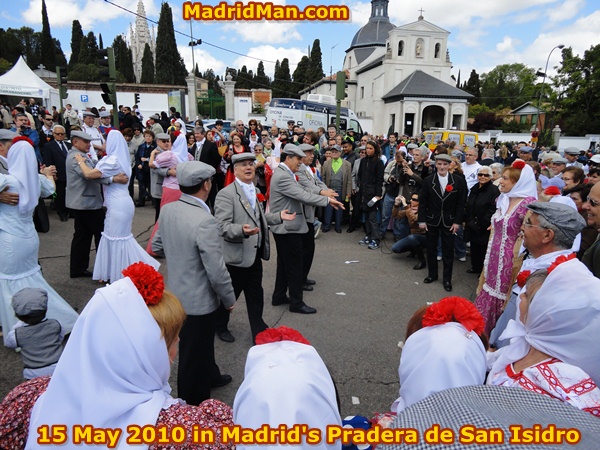
In contrast to the underwhelming observation of Europe Day, the next Saturday was the festival of San Isidro, patron saint of Madrid. According to Pilar, San Isidro used to be a small affair characterized by a single folk dance event. It has since grown and this year was a huge celebration in honor of the 100th birthday of Gran Vía, the main street of Madrid. I checked out the Gran Vía first thing in the morning. It was covered from end to end in a bright blue carpet that erupted into celebration around 6:00 PM. What exactly people were doing on the carpet was not exactly clear. There were performances on either end (at Plaza de España and Red de San Luis), but in the middle there were many, many blocks in which the only excitement was the blue carpet. This did not phase the Spanish, who turned out in huge numbers to walk back and forth on the carpet, watch people do impromptu traditional dance performances, and sit down and drink. It's hard to believe that it would be difficult to move because everyone was crowding to see not much of anything. Other excitements included the traditional folk festival for which the holiday is known, a very avant-garde theater festival in Lavapiés (the immigrant neighborhood to my north), and a giant cake sculpture in Plaza de Callao. There were also fireworks at night.
Also, the number of men wearing black and white tweed vests, jackets and flat caps was astounding. This is apparently the traditional Madrileño costume, with women wearing not particularly elaborate white and black/blue/red polka-dotted dresses. Given how pretty the traditional dress in Valencia was during Las Fallas, it was a bit of a letdown. I did learn, however, that it represents Madrid's unofficial "chulo" attitude, which means something between cool and cocky.


As an added bonus (it took me weeks to get this post out) I saw a third festival, the "Homonaje a María Auxiliadora", which best I can do translates roughly to "Homage to the Assistant Mary" (according to some websites, it is because she is the "assistant" to God). The church on my street goes by the same name, so on her saint day, there was a celebration. After what I can only assume were many masses, a procession was held in my neighborhood, complete with horseback riders, two bands, adorable children, a giant statue of the Virgin on a float being pulled by two people with a ring of supporters around them, widows dressed in black, and a few priests. Afterward, there was a surprisingly good firework display. I'm not quite sure the religious significance of fireworks, but then again I don't understand virtually anything about Spanish Catholicism, and since no one I know really believes in it, I don't foresee an end to my confusion anytime soon.

This weekend I'm off to Basque Country! Nire aerolabangailua aingirez beteta dago!

*As a side note, Paco, my portero, expressed his concern to me this week that it must be very difficult for Americans to meet girls, since they don't spend enough time out in the streets, presumably drinking. I assured him that college culture makes it quite easy, and after that, there are pleanty of house parties and bars, but it didn't really translate culturally. Residential colleges seem just as real to many Europeans as cowboys. I once had an Austrian coworker (in the U.S.) ask me whether fraternities really existed or whether they were just from movies. Moreover, house parties and going to a bar to meet people make little sense in Spain. People only invite close friends into their houses and in my experience, going alone to a bar or club is generally viewed poorly. I once had someone ask if I was feeling okay when I was sitting alone in a lounge, because obviously this meant that I was sick and was taking a break while my friends danced.
**Both don't have lyrics that are used anymore; in the case of Europe because of laguage issues, and for Spain because the words were written by Franco. Because of this, Marcha Real usually seems silly, but less so when paired with Ode to Joy. Also, I say "European" rather than "EU", because these symbols were originally used by the Council of Europe, which is an unrelated human rights body. The Council of Europe also observes Europe Day, but on 5 May to commemorate its founding.
Saturday, May 8, 2010
Education in Turkey
I admit that this blog has been pretty Evan-heavy lately. I apologize. I had a couple weeks of midterms mixed with weekly traveling, so the blog needed to take a break. My midterm results have been mixed so far. I got the high score in Control Systems, which was announced to the class in a very public give-a-chocolate-bar-to-the-high-scorer ceremony. The chocolate bar had pistachios in it and was rather delicious. It almost justified the alienation that may come from my classmates for my handing their collective asses* to them. On the other hand, I got the average score in Advanced Strength of Materials, which between METU’s and Mudd’s high standards means that I am currently failing.
This segues into a trend that I’ve been seeing at METU. The long of the short of it is that Turkey is educationally screwed and there is very little they can do about it. Let me explain…
Education is a big deal in Turkey. Both high school and university have rigorous entrance exams with engineering being one of the most competitive fields. Only the top 5000 or so students out of over a million every year are allowed to enroll in METU or ITU in mechanical or electrical engineering. To get in, many METU students spend their after school hours “dershaneler” (class houses) for up to six years before the university admissions test.
All this studying makes students really good at memorizing things. This isn’t exactly helped by a class structure where the professors see themselves as providers of information rather than educators. While they lecture for three hours a week, they expect the students to teach themselves the material. As the students have perfected memorizing, they employ it as study skill #1.
In mechanical engineering, this memorization obsession is thankfully minimal. Though they sometimes reward speed and perfection more than they should, the tests are pretty problem-solving intensive. According to Johnny, chemistry is a different story. There, the professors have seemingly given up on teaching their students to do chemistry. Labs are pre-planned and tests are pretty exclusively based in rote memorization.
The sad thing is that the professors do not really endorse this type of education. METU has required its professors to get their Ph.D.s abroad for decades, and many know the importance of critical thinking. They are either too lazy or afraid to do anything about it though. The students have been memorizing since early in their careers and no professor in departments like chemistry wants to be the first one to break the cycle. They know that if they request more of their students, nobody will be able to pass their examinations. Some professors have tried.
The result is a country of competent students that will do nothing extraordinary with their lives. Most of the students here are studying so they can have steady work. Passion is not as highly rated. One student told me that it was a perfect time to be an engineer in Turkey, since Ford was outsourcing their more tedious engineering tasks there. This student (who is apparently near the top of his class) might be the ideal candidate for such work, seeing as he said that he could not conceive anything vastly new being engineered in the next hundred or so years.
So why doesn’t anyone do anything? No matter what happens, these students are going to get METU degrees and they will be set for life. They can become professors or professionals and live the good life whether or not they actually learn useful information. This is the Turkish Dream: obtain a high-status position that allows you to live comfortably and put little additional effort into your work.
So relax, America. We still have a huge educational advantage. Even though our educational system sometimes eschews learning for “talking about our feelings” and the like, it teaches critical thinking and makes students dream big.
*I apologize to anyone reading this blog that doesn’t know that word.
Wednesday, May 5, 2010
My Turkish Teacher Wrote this Post for Me
My current Turkish teacher Çiğdem, is the most excitable person I have ever met. Her voice has a range of four octaves, and she uses all of them to express her (always strong) emotion about whatever we are talking about. One of the big elements of class is conversation. About half of every class is just spent talking about whatever Çiğdem or anyone else wants to. Topics have included everything from UFOs to whether they put stray animals in cheap döner, to why women get cellulite. So long as the conversation remains in Turkish (or Swahili*), everything is fair game.
Thanks to Çiğdem, I also have an easy blog post. Who wants to know what noises animals make? I did. It turns out Johnny wanted to know the names of just about every organ in the body in Turkish. Also as an added bonus, Çiğdem wanted to teach us a bunch of similes in Turkish. So without further adieu, here is a sizable portion of my Turkish notes from a couple of weeks ago
Animal Noises:
Lamb, Goat: meeeee
Cat: miyav
Dog: hav
Cow: möö
Donkey: ai ai
Horse: iii
Chicken: gı gı gı gıdak
Rooster: ü-ürü-ürü
Crow: gak
Wolf: uuuuuuuuuuuh
Frog: vrak
Cat: miyav
Dog: hav
Cow: möö
Donkey: ai ai
Horse: iii
Chicken: gı gı gı gıdak
Rooster: ü-ürü-ürü
Crow: gak
Wolf: uuuuuuuuuuuh
Frog: vrak
Similes:
Dangerous like a snake
Timid like a rabbit
Hard working like a cow
Docile like a lamb
Tall like a giraffe
Rude like a bear
Early-rising like a chicken
In love like a dove
Loyal like a dog
Ungrateful like a cat
Sly like a fox
Quiet like a mouse
Hungry like a worm
Fast like a horse
Timid like a rabbit
Hard working like a cow
Docile like a lamb
Tall like a giraffe
Rude like a bear
Early-rising like a chicken
In love like a dove
Loyal like a dog
Ungrateful like a cat
Sly like a fox
Quiet like a mouse
Hungry like a worm
Fast like a horse
Hot like hell
Cold like ice
Light like a feather
Lazy like a dead donkey
White like cotton
Dark like Night
Spicy/Salty like poison
Smelly like a carcus
Good smelling like musk
Eyes like almonds
Lips like small roses
Teeth like pearls
Rich like a landowner
Cold like ice
Light like a feather
Lazy like a dead donkey
White like cotton
Dark like Night
Spicy/Salty like poison
Smelly like a carcus
Good smelling like musk
Eyes like almonds
Lips like small roses
Teeth like pearls
Rich like a landowner
I would list organs, but I doubt anyone wants to say gallbladder in Turkish. Comment if you dissagree.
*One day we were playing Taboo and a student asked if they were supposed to call out the word in Turkish (the answer was obviously yes, since the while class is in Turkish). Çiğdem replied, “No, answer in Swahili” at which point, the student asking the question (British) and another student (American) started chatting in Swahili. Çiğdem brings this up almost every day now.
Monday, May 3, 2010
A Positive Post
A forward: This weekend, I went with some friends from my program to Galicia, an autonomous community in the northwest of the country, right above Portugal. We had a really good time. We couchsurfed with a charming EU translator named Mercedes, who lived out in a development in the countryside. The first day, we tried to go to Finisterre, the formerly supposed "end of the world", but there weren't any buses for a few hours, so we went to A Coruña to see, among other things, the world's oldest operating lighthouse. The second day, we went to Santiago de Compostela, a famous pilgrimage site. The cathedral there contains the supposed remains of St. James (the apostle), and we got a chance to go on the roof. It was a really nice trip overall, and apparently pretty unusual for Americans to take, because we kept on getting asked where we were from, which never happens in Madrid*, or at least it's unusual for Americans to take buses to little towns of no interest to foreigners. We also got to see a Spanish bachelor's party, in which a groom's best friends take him out all weekend for drunken shenanigans. They were still out from the night before at 10 AM.
Anyway, I was going to write a post mocking Spanish multilingual policies, which are responsible for Gallego having a protected status in Galicia, even though it differs from Castellano by only a handful of phonological transformations and a slightly different lexicon. Meanwhile, other dialects, like Asturian, get no protection because no one bothered writing in them before the Civil War. It would be a little like if Cockney were considered a different language because someone wrote in it phonetically. However, on my commute to my internship office, I decided to write something positive instead:
Spanish people are really caring. I don't give them enough credit for this. Among foreign students and expats, Spaniards have a reputation for being cold and judgmental. They don't wish you a nice day in stores, they don't act friendly unless they like you, and they say what they feel even if it isn't very nice or politically correct. They have the opposite complaint about us - we're too artificial and never act honestly towards others. Among friends or friends of friends, they're caring and considerate, even if they've never met you. At times, this can be really frustrating. It can feel like no one likes you, when in reality, they just don't know you.
This morning brought out the best in Spanish social customs. On my way out, I said hello to my portero, Paco. Porteros are sort of like building caretakers - they come in a few hours a day to sort the mail, clean the lobby, and do some simple maintenance. Paco has always been really nice to me, as he seems to have been to all the students who stay with Pilar.** I was sort of in a rush, but he stopped to chat with me, even following me as I went towards the door. His wife gave birth to a son, their third child, on Wednesday. He was really proud. He then wanted to know about my weekend and all the places I went to (though he admonished me for not calling A Coruña by its Castellano name, "La Coruña"). Paco isn't a doorman - his job isn't to be nice to the residents - he's just a really nice guy who likes to chat. He even stopped me once when I ran into him on the street to introduce me to his family and talk for a while. It's nice that he would take some time from his job to talk to the silly foreigner who can't speak well in the morning.
My metro ride was also a nice reminder of how kind people here are. I've always found the metro remarkably civil compared to the New York subway, where you spend all your time averting your eyes from everyone else. The cars are narrow, but everyone is always very courteous. From time to time, a homeless person will get on and make a brief speech about how they need help. They aren't demanding or trying to guilt-trip; they just explain their situation and what they need. They then quietly go through the car and people give them food or a few coins with remarkable generosity. Homeless people aren't viewed with suspicion, and everyone assumes they really will use the money to get a room for the night. If an elderly person gets on, people rush to leave their seats for them. This morning, two younger women argued with and older but healthy woman about how she should take their seats. It was really sweet.
This follows an experience in A Coruña, where an elderly woman asked us in a cemetery if we could put flowers on a third-tier grave for her. Although she criticized us jokingly for letting a female friend climb the ladder (she was lightest), she was extremely thankful, gave us all kisses, and kept on wishing us blessings. When you get down to it, people here can come off as cold, but they really do look out for those they don't know. In many ways, it's quite a nice and caring society
*So rare, in fact, that it took one of my friends a while to realize what he was being asked. We almost never hear the informal 2nd person plural permanent "to be" verb "sois", as in "¿De dónde sois?" ("Where are you guys from?"). They don't really teach the informal 2nd person plural (called "vosotros") in the U.S. because it isn't used in Latin America, so it sometimes takes us by surprise.
**If someone has a Sacajawea dollar or two that they wouldn't mind sending to me (I'll pay you back), I think it would be a nice thing to give to him when I leave. He collects coins and I know he's been looking for some.
Another note: David had better write something here soon. This is rapidly becoming my blog and I get the impression that my adventures are less exciting.
Anyway, I was going to write a post mocking Spanish multilingual policies, which are responsible for Gallego having a protected status in Galicia, even though it differs from Castellano by only a handful of phonological transformations and a slightly different lexicon. Meanwhile, other dialects, like Asturian, get no protection because no one bothered writing in them before the Civil War. It would be a little like if Cockney were considered a different language because someone wrote in it phonetically. However, on my commute to my internship office, I decided to write something positive instead:
Spanish people are really caring. I don't give them enough credit for this. Among foreign students and expats, Spaniards have a reputation for being cold and judgmental. They don't wish you a nice day in stores, they don't act friendly unless they like you, and they say what they feel even if it isn't very nice or politically correct. They have the opposite complaint about us - we're too artificial and never act honestly towards others. Among friends or friends of friends, they're caring and considerate, even if they've never met you. At times, this can be really frustrating. It can feel like no one likes you, when in reality, they just don't know you.
This morning brought out the best in Spanish social customs. On my way out, I said hello to my portero, Paco. Porteros are sort of like building caretakers - they come in a few hours a day to sort the mail, clean the lobby, and do some simple maintenance. Paco has always been really nice to me, as he seems to have been to all the students who stay with Pilar.** I was sort of in a rush, but he stopped to chat with me, even following me as I went towards the door. His wife gave birth to a son, their third child, on Wednesday. He was really proud. He then wanted to know about my weekend and all the places I went to (though he admonished me for not calling A Coruña by its Castellano name, "La Coruña"). Paco isn't a doorman - his job isn't to be nice to the residents - he's just a really nice guy who likes to chat. He even stopped me once when I ran into him on the street to introduce me to his family and talk for a while. It's nice that he would take some time from his job to talk to the silly foreigner who can't speak well in the morning.
My metro ride was also a nice reminder of how kind people here are. I've always found the metro remarkably civil compared to the New York subway, where you spend all your time averting your eyes from everyone else. The cars are narrow, but everyone is always very courteous. From time to time, a homeless person will get on and make a brief speech about how they need help. They aren't demanding or trying to guilt-trip; they just explain their situation and what they need. They then quietly go through the car and people give them food or a few coins with remarkable generosity. Homeless people aren't viewed with suspicion, and everyone assumes they really will use the money to get a room for the night. If an elderly person gets on, people rush to leave their seats for them. This morning, two younger women argued with and older but healthy woman about how she should take their seats. It was really sweet.
This follows an experience in A Coruña, where an elderly woman asked us in a cemetery if we could put flowers on a third-tier grave for her. Although she criticized us jokingly for letting a female friend climb the ladder (she was lightest), she was extremely thankful, gave us all kisses, and kept on wishing us blessings. When you get down to it, people here can come off as cold, but they really do look out for those they don't know. In many ways, it's quite a nice and caring society
*So rare, in fact, that it took one of my friends a while to realize what he was being asked. We almost never hear the informal 2nd person plural permanent "to be" verb "sois", as in "¿De dónde sois?" ("Where are you guys from?"). They don't really teach the informal 2nd person plural (called "vosotros") in the U.S. because it isn't used in Latin America, so it sometimes takes us by surprise.
**If someone has a Sacajawea dollar or two that they wouldn't mind sending to me (I'll pay you back), I think it would be a nice thing to give to him when I leave. He collects coins and I know he's been looking for some.
Another note: David had better write something here soon. This is rapidly becoming my blog and I get the impression that my adventures are less exciting.
Subscribe to:
Posts (Atom)